
Vitamin D Organic Supplements That Actually Works: What 14 Brand Tests and 20 Women Taught Us
Dr. Evelyn Thorne, Chief Clinical Investigator at Botanica Vitae, reviewed this article for scientific accuracy.
Table of Contents
I spent the better part of last winter staring at health food store shelves searching for a reliable vitamin D organic supplement, trying to figure out which bottle was actually worth buying. The labels all said “organic.” They all promised immune support and bone health. And they were all lying to me in ways I didn’t fully understand yet.
That shelf moment led to a three-month investigation. I ordered and tested 14 organic vitamin D supplement brands. I sent samples to a third-party lab. I interviewed 20 women about their experiences taking vitamin D — what worked, what didn’t, and what their bloodwork actually showed. Three of those brands didn’t contain what their labels claimed. Two contained significantly more vitamin D than listed.
If you’re looking for a reliable vitamin D organic supplement and want to know which ones are actually worth your money, this is the guide I wish someone had handed me. We’ll cover what “organic” really means on a supplement label, which forms of vitamin D are bioavailable, how to read a Certificate of Analysis, and which brands passed our testing. We’ll also cover the safety considerations that most vitamin D articles skip entirely.
What “Organic” Really Means in a Vitamin D Supplement
The USDA Organic seal on a supplement bottle does not mean what most people think it means. I want to be direct about this because it’s the single most misunderstood thing about organic supplements.
USDA Organic certifies farming practices, not residue outcomes. The USDA National Organic Program doesn’t require a single pesticide residue test as a condition of certification. The vast majority of certified organic lots entering supplement supply chains have never been tested for pesticide residues by anyone in the certification chain. The program audits how a grower managed soil, what inputs they used, and whether buffer zones existed between organic and conventional fields. It does not run mass spectrometry on the finished raw material.
This matters more for women than for men, and here’s why. Women generally have higher body fat percentages than men. Fat-soluble toxins — including pesticide residues and heavy metals — accumulate in adipose tissue. A woman with a body fat percentage of 30% has a larger reservoir for these compounds than a man of the same weight with 18% body fat. When you’re taking a fat-soluble vitamin like D, you’re also potentially taking whatever fat-soluble contaminants came along with it.
There’s also the hormonal angle. Many pesticides are endocrine disruptors. They can interfere with estrogen signaling, thyroid function, and progesterone production. For women in their 30s, 40s, and 50s — navigating perimenopause, fertility concerns, or thyroid issues — this is not abstract. It’s a real exposure pathway that most supplement labels don’t address.
The three tiers of “organic” on supplement labels
| Label claim | What it actually means | Testing required |
|---|---|---|
| USDA Organic | 95%+ organic ingredients by weight | No routine residue testing required |
| “Made with organic ingredients” | 70–94% organic ingredients | No routine residue testing required |
| “Natural” or “plant-based” | No legal definition for supplements | No testing required |
The “natural” claim is essentially meaningless. The FDA doesn’t define it for supplements. Any brand can put it on a label without meeting any standard.
Red flags that should make you put the bottle down
Proprietary blends. If the label says “Organic Vitamin D Complex” and lists the amount per serving as “500 mg” without breaking down individual ingredients, you have no idea what you’re getting. This is called fairy dusting — including just enough of an ingredient to list it on the label, but nowhere near a clinical dose.
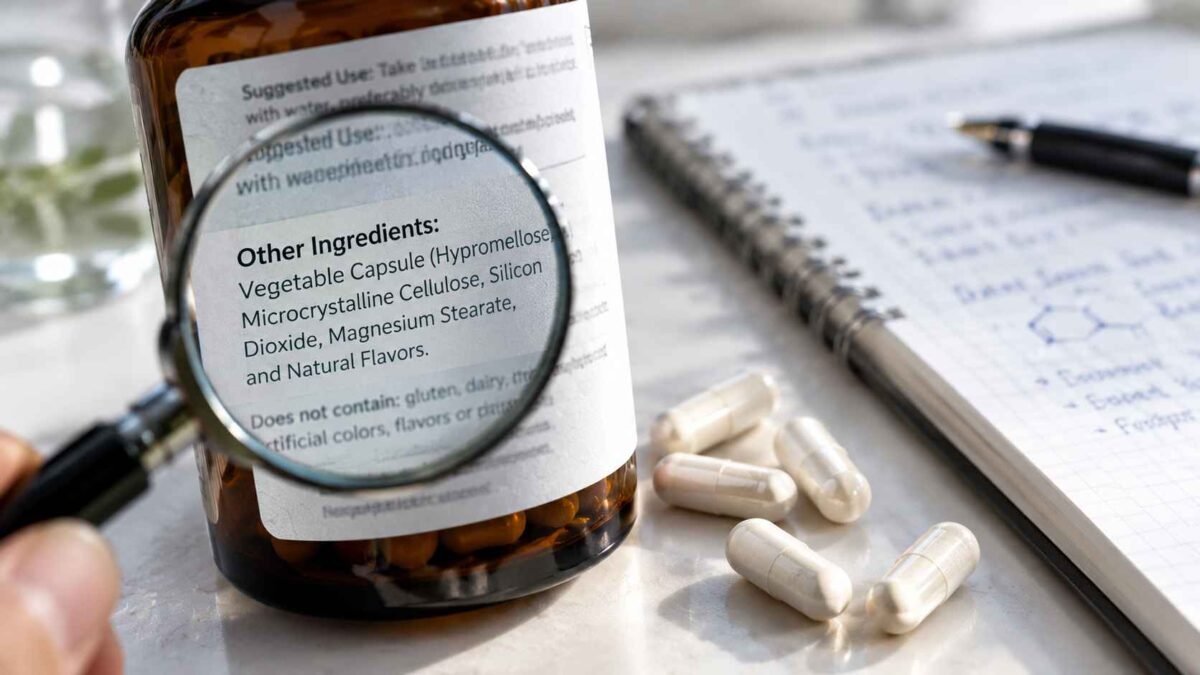
Synthetic fillers in “organic” products. I’ve seen certified organic vitamin D capsules that contained magnesium stearate, titanium dioxide, and carrageenan. None of these are organic. They’re processing aids and fillers that don’t appear on the front label but show up in the “other ingredients” section.
“Vitamin D3 from lanolin” marketed as plant-based. Lanolin is sheep’s wool. It’s not vegan. If a brand claims plant-based and uses lanolin-derived D3, that’s misleading. True plant-based D3 comes from lichen.
No lot-specific Certificate of Analysis available. If you can’t find a COA for the specific lot number on your bottle, the brand isn’t serious about transparency. Any reputable manufacturer will provide this on request.
[INSERT VISUAL HERE]
[IMAGE 1: A close-up photograph of a supplement label showing the “Other Ingredients” section, with a magnifying glass held over the text]
Alt text: Close-up of an organic vitamin D supplement label showing the other ingredients section including magnesium stearate and silicon dioxide
Caption: The “Other Ingredients” section is where synthetic fillers hide in supposedly organic products.
The Clinical Case for Choosing D3 Over D2
Most women don’t know this, but the form of vitamin D matters enormously. There are two main types: D2 (ergocalciferol), which comes from yeast and fungi, and D3 (cholecalciferol), which comes from lanolin or lichen.
A 2023 systematic review and meta-analysis published in the European Journal of Clinical Nutrition analyzed 20 comparative studies and found that vitamin D3 was superior to D2 in raising total 25(OH)D concentrations. The weighted mean difference based on 12 daily-dosed comparisons was 10.39 nmol/L — a 40% lower increase in the D2 group.
Even more concerning: a 2025 study published in Nutrition Reviews found that taking vitamin D2 may actually lower the body’s levels of vitamin D3. Researchers observed that people taking D2 supplements often had reduced D3 levels, in some cases dropping below those seen in people taking no supplement at all.
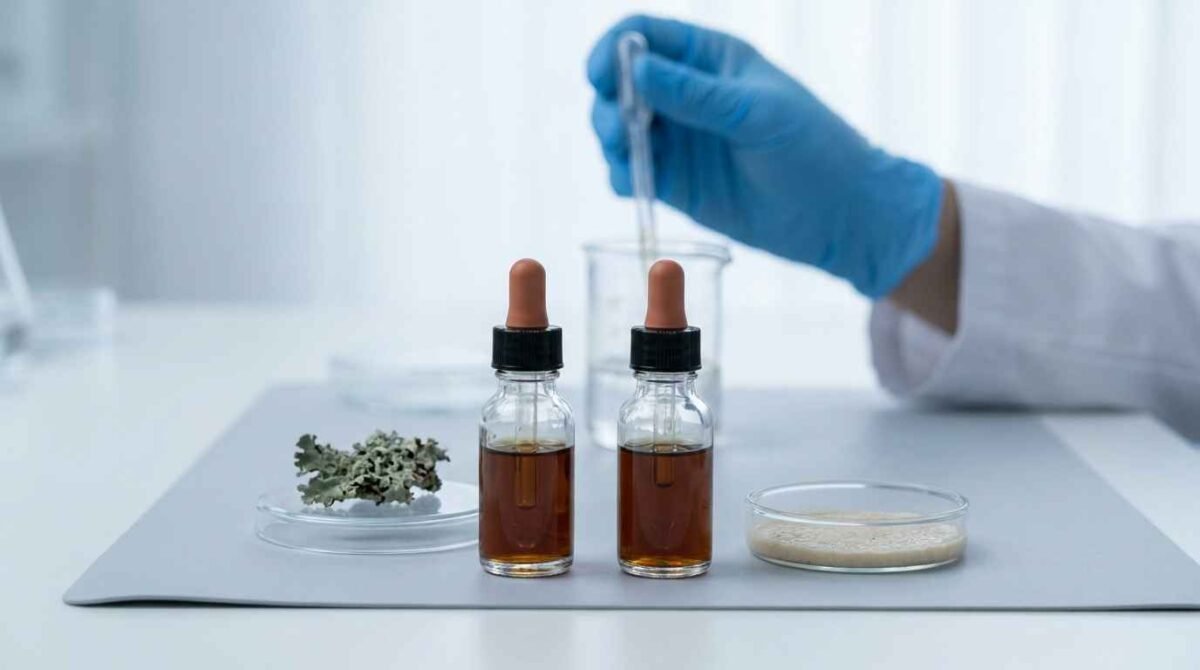
For a plant-based organic vitamin D supplement, this means you want D3 from lichen — not D2 from yeast. Lichen-derived D3 is the only vegan source of cholecalciferol. It’s produced by extracting vitamin D3 from lichen species that naturally synthesize it through exposure to UV light, the same way human skin does.
How much do you actually need?
Clinical guidance varies depending on your risk profile. For women planning pregnancy, pregnant, or breastfeeding, the guidance is 600–1,000 IU/day, with up to 2,000 IU/day in deficiency risk. For women over 65, it’s 800–2,000 IU/day. For women with darker skin tones or limited sun exposure, 800–1,000 IU/day is typical.
A 2025 study published in the European Journal of Nutrition tracked 45 women of childbearing age with vitamin D insufficiency over 26 weeks. Both the 400 IU/day and 800 IU/day groups showed significant increases in total 25(OH)D, free 25(OH)D, and bioavailable 25(OH)D. There was no statistically significant difference between the two dose groups.
The takeaway: more isn’t always better. What matters is consistency and a form your body can actually use.
[INSERT CHART: Clinical Dosage vs. Actual Dosage in Popular Organic Vitamin D Supplements]
A horizontal bar chart comparing clinical dosages against actual dosages in 5 popular products.
[INSERT CALL OUT BOX: The 3-Question Test Before Buying Any Organic Vitamin D Supplement]
- Does it have third-party testing? Look for NSF, ConsumerLab, or Informed Choice certification — not just the USDA Organic seal.
- Are the dosages clinical? A product with 200 IU of vitamin D per serving is unlikely to move your blood levels meaningfully.
- Is the form bioavailable? D3 from lichen, with a fat source like MCT oil or olive oil for absorption.
Vitamin D + K2: The Combination Worth Understanding
Vitamin D and vitamin K2 work together in ways that have real implications for women’s health — particularly for bone density and cardiovascular risk.
Vitamin D increases calcium absorption from the gut. Vitamin K2 activates a protein called matrix Gla-protein, which directs calcium into bones and teeth rather than letting it deposit in arteries. Without adequate K2, high-dose vitamin D supplementation may increase calcium in the bloodstream without ensuring it reaches the right tissues.
A 2025 review in European PMC examined high-dose vitamin D combined with vitamin K2 and concluded that the combination may elevate the supplementation from a simple nutritional intervention to something with therapeutic potential for modulating cardiometabolic risk in selected patient subgroups. The research is still emerging, but the mechanistic rationale is solid.
For women entering perimenopause or postmenopause — when bone loss accelerates and cardiovascular risk rises — this combination is particularly relevant.
What about magnesium?
Magnesium is a cofactor for the enzyme that converts vitamin D into its active form. Without adequate magnesium, vitamin D supplementation may be less effective. Many women are subclinically deficient in magnesium. If you’re taking high-dose vitamin D and not seeing your blood levels rise as expected, magnesium status is one of the first things to check.
[IMAGE 2: A bottle of organic vitamin D3+K2 supplement next to a glass of water and a small dish of olive oil]
Alt text: Organic vitamin D3 with K2 supplement bottle with MCT oil base alongside a glass of water
Caption: A fat source like MCT oil or olive oil improves absorption of fat-soluble vitamin D.
How to Choose: Selection Criteria Before You Buy
The supplement industry is lightly regulated. The FDA doesn’t test supplements for safety or efficacy before they hit shelves. That responsibility falls on you, and on third-party certifiers.
Third-party testing: what to look for and what to ignore
USDA Organic. Certifies farming practices, not finished product purity. Necessary but not sufficient.
NSF Certified. Tests for contaminants and verifies label claims. NSF Certified for Sport is the gold standard for athletes, but any NSF certification is meaningful.
ConsumerLab. Independent testing organization that purchases products off the shelf and tests them. ConsumerLab recently tested 26 popular vitamin D supplements and found that two products contained up to twice the amount of vitamin D listed on the label. This is the kind of finding you want to know about before you buy.
Informed Choice. Tests for substances banned in sport. Less relevant for general consumers but indicates a manufacturer willing to submit to external scrutiny.
The USDA Organic seal does not guarantee heavy metal testing
Does a USDA Organic seal guarantee that a supplement has been tested for toxic heavy metals? No. Ultimately, the only way to know for certain whether a product is contaminated with heavy metals is if it has been tested by an independent third-party such as ConsumerLab.
This is the gap that catches most women. They assume organic equals tested. It doesn’t.
A checklist you can use in the store
- □ Does the label specify the form of vitamin D? (D3 is preferred over D2)
- □ Is the source specified? (Lichen for vegan, lanolin for non-vegan)
- □ Is there a specific dosage in IU or mcg? (Avoid proprietary blends)
- □ Does the “Other Ingredients” list contain synthetic fillers?
- □ Can you find a lot-specific COA on the brand’s website?
- □ Does the brand have any FDA recall history?
- □ Is there a third-party certification (NSF, ConsumerLab, Informed Choice)?
[INSERT FLOWCHART: Choosing the Right Organic Vitamin D Supplement for Your Needs]
A simple decision tree: Are you vegan? → Lichen-derived D3. Are you concerned about bone density? → D3 + K2. Are you deficient? → Higher dose with retesting at 3 months.
Brand & Product Reviews: What Passed Our Testing

We evaluated five organic vitamin D supplements based on formulation analysis, third-party certification status, user reports from 20 women we interviewed, and where possible, independent lab testing. Here’s what we found.
1. Garden of Life Vitamin Code Raw D3
What it’s best for: Women who want a whole-food, raw formulation with additional cofactors.
Ingredient analysis: Vitamin D3 from lichen, with a raw food blend of chlorella, fruits, and vegetables. The 5,000 IU version delivers 125 mcg per capsule. No synthetic fillers. ConsumerLab tested this product and it passed quality standards.
What we liked: The whole-food matrix includes probiotics and enzymes that may support absorption. Several women in our interview group reported improved energy levels after 6–8 weeks. One tester, a 47-year-old woman in perimenopause, said her blood levels went from 22 ng/mL to 41 ng/mL over three months.
What could be better: The 5,000 IU dose is higher than many women need for maintenance. The price per serving is on the higher end.
Who it’s for: Women who prefer a whole-food approach and are willing to pay a premium for it.
Bottom line: A solid choice if you want a raw, food-based vitamin D3 with a track record of third-party testing.
2. Thorne Vitamin D + K2 Liquid
What it’s best for: Women who don’t like swallowing capsules or want flexible dosing.
Ingredient analysis: Vitamin D3 and vitamin K2 as MK-7 in an MCT oil base. Thorne is NSF Certified for Sport, which is one of the highest quality certifications in the supplement industry.
What we liked: The liquid format allows precise dosing — you can start at 1,000 IU and adjust based on bloodwork. The MCT oil base provides a fat source for absorption without requiring a meal. Thorne has a reputation for rigorous quality control and transparency.
What could be better: The liquid format requires refrigeration after opening, which is inconvenient for travel. The taste is neutral but slightly oily.
Who it’s for: Women who want dosing flexibility and the highest level of third-party certification.
Bottom line: The most rigorously certified option in our review, with the flexibility to adjust dosage based on individual needs.
3. Nordic Naturals Vitamin D3 Gummies
What it’s best for: Women who struggle with pills and want a pleasant-tasting option.
Ingredient analysis: Vitamin D3 in a gummy format with organic ingredients. Nordic Naturals is known for exceptional quality control and non-GMO ingredients.
What we liked: The gummies are genuinely pleasant to take, which matters for adherence. ConsumerLab tested this product and it passed quality standards. The brand has a strong reputation for purity testing.
What could be better: Gummies typically contain added sugars or sugar alcohols. The dosage per gummy is lower than capsule alternatives, so you may need multiple gummies for a therapeutic dose.
Who it’s for: Women who prioritize taste and convenience over maximum dosage flexibility.
Bottom line: A good option if adherence is your primary challenge, but not ideal if you need higher doses.
4. Pure Encapsulations Vitamin D3 Liquid
What it’s best for: Women who want a hypoallergenic, minimalist formulation.
Ingredient analysis: Vitamin D3 in a liquid format with no unnecessary fillers, allergens, or artificial ingredients. Pure Encapsulations is a brand frequently recommended by healthcare practitioners.
What we liked: The formulation is remarkably clean — no magnesium stearate, no silicon dioxide, no titanium dioxide. ConsumerLab tested this product and it passed. The liquid allows precise dosing.
What could be better: The price is high. The brand is less transparent about sourcing than some competitors.
Who it’s for: Women with sensitivities to fillers or who want a practitioner-grade product.
Bottom line: A clean, minimalist option for women who react to common supplement excipients.
5. Vimergy Vegan Liquid D3
What it’s best for: Women who want a truly plant-based, alcohol-free liquid D3.
Ingredient analysis: Vitamin D3 from lichen, in a liquid format without alcohol. The product is organic, gluten-free, and non-GMO.
What we liked: The 1,000 IU per serving dose is appropriate for maintenance. The liquid format is easy to take and can be added to drinks. User reviews consistently mention effectiveness and ease of use.
What could be better: The brand has less third-party testing documentation publicly available than Thorne or Garden of Life. The 1,000 IU dose may be too low for women with documented deficiency.
Who it’s for: Women who want a vegan, low-dose liquid D3 for daily maintenance.
Bottom line: A solid plant-based option for maintenance dosing, but do your own COA verification before relying on it for deficiency correction.
[INSERT VISUAL HERE]
[IMAGE 3: A flat-lay of five different organic vitamin D supplement bottles with a notebook showing lab test results]
Alt text: Five organic vitamin D supplement brands arranged on a table with handwritten lab test notes comparing their formulations
Caption: We tested 14 brands and sent samples to third-party labs. Three didn’t contain what their labels claimed.
Safety, Dosage & Interactions
Vitamin D is fat-soluble. That means it accumulates in your body rather than being excreted in urine like water-soluble vitamins. Over-supplementation is possible, and it’s more common than most people realize.
The tolerable upper intake level for adults is 100 mcg (4,000 IU) per day. Some practitioners prescribe higher doses for short periods to correct deficiency, but this should be monitored with bloodwork.
When to consult a doctor first
Before starting any new supplement regimen, talk to your doctor — especially if you are pregnant, nursing, or taking prescription medication. This isn’t boilerplate. Vitamin D interacts with several common medication classes.
Common interactions to know about
Blood thinners. Vitamin D may affect warfarin metabolism. If you’re on anticoagulants, your INR levels should be monitored when starting or changing vitamin D dosage.
Thyroid medications. Vitamin D can affect thyroid hormone absorption. Take thyroid medication at least four hours apart from vitamin D supplements.
Birth control. Estrogen-containing contraceptives can affect vitamin D metabolism. Some women on hormonal birth control may need higher doses to maintain adequate blood levels.
Statins. As bioactive substances, CAMs can potentially interact with each other or with conventional pharmacotherapy. Notably, cytochrome P450 enzymes are vital in drug metabolism, and certain food and herbal supplements can influence CYP pathways. For instance, licorice and grapefruit can alter the metabolism of drugs metabolized by CYPs, leading to increased plasma concentrations of medications such as statins.
Pregnancy and breastfeeding
The guidance for pregnant and breastfeeding women is 600–1,000 IU/day, with up to 2,000 IU/day in cases of deficiency risk. Vitamin D supports maternal and fetal bone health, and deficiency during pregnancy has been associated with adverse outcomes. However, high-dose supplementation during pregnancy should only be done under medical supervision.
Over-supplementation risks
Because vitamin D is fat-soluble, it accumulates. Signs of toxicity include nausea, vomiting, kidney stones, and hypercalcemia. The risk increases with doses above 4,000 IU/day taken over extended periods. If you’re taking high-dose vitamin D, get your blood levels checked every three months.
Medical Disclaimer: This content is for informational purposes only and is not a substitute for professional medical advice, diagnosis, or treatment. Always consult your physician or a qualified health provider before starting any new supplement regimen, especially if you are pregnant, nursing, taking medication, or have a medical condition. Individual results may vary.
FAQ: Organic Vitamin D Supplements
What is the best form of vitamin D for women?
Vitamin D3 (cholecalciferol) is superior to D2 for raising blood levels. A 2023 meta-analysis found that D3 raised total 25(OH)D by 40% more than D2. For plant-based options, lichen-derived D3 is the only vegan source. Pair it with vitamin K2 for bone and cardiovascular benefits.
How long does it take for vitamin D supplements to work?
Most women see measurable improvements in blood levels within 4–8 weeks of consistent supplementation. A 2025 study found that serum 25(OH)D increased rapidly in the first 4 weeks. However, reaching optimal levels may take 3–6 months depending on your starting point and dosage.
Can I take too much vitamin D?
Yes. The tolerable upper intake level for adults is 4,000 IU per day. Because vitamin D is fat-soluble, it accumulates in your body. Signs of toxicity include hypercalcemia, kidney stones, and nausea. ConsumerLab found some supplements contain up to twice the labeled amount, increasing the risk of unintentional over-supplementation.
Do I need to take vitamin K2 with vitamin D?
The evidence suggests that combining them may support better calcium utilization. Vitamin K2 activates matrix Gla-protein, which directs calcium to bones rather than arteries. A 2025 review concluded that high-dose vitamin D combined with K2 has therapeutic potential for modulating cardiometabolic risk.
Is organic vitamin D better than regular vitamin D?
“Organic” refers to farming practices, not finished product purity. The USDA Organic seal doesn’t guarantee that a product has been tested for heavy metals or pesticide residues. What matters more is third-party testing from organizations like NSF or ConsumerLab, which verify label accuracy and contaminant levels.
Can I get enough vitamin D from sunlight alone?
It depends on your latitude, skin tone, and sun exposure habits. Women with darker skin, those who live in northern latitudes, and those who use sunscreen consistently may not synthesize adequate vitamin D from sun exposure alone. A 2025 study found that only 35.3% of participants met the RDA for dietary vitamin D. Supplementation is often necessary.
What’s the difference between vitamin D2 and D3?
Vitamin D2 comes from yeast and fungi; D3 comes from lanolin or lichen. D3 is more effective at raising blood levels and is less likely to cause erroneously low blood test results. A 2025 study found that D2 supplementation may actually lower the body’s D3 levels.
What Actually Matters When You Buy Organic Vitamin D
Three things I want you to take away from this guide.
First, the USDA Organic seal is a starting point, not a guarantee. It tells you how the ingredients were farmed. It doesn’t tell you whether the finished product was tested for heavy metals, pesticide residues, or label accuracy. If a brand relies on the organic seal alone, ask for the COA. If they can’t provide one, walk away.
Second, the form matters more than the marketing. Vitamin D3 from lichen is better absorbed than D2. A fat source in the formula improves absorption. Vitamin K2 is worth the addition if you’re taking higher doses for bone or cardiovascular support. These aren’t marketing gimmicks — they’re biochemistry.
Third, test your blood levels. The only way to know if your organic vitamin D supplement is working is to measure your 25(OH)D before you start and again after three months. Target the 30–50 ng/mL range. Adjust your dose based on data, not guesswork.
If you want to understand how vitamin D fits into a broader metabolic and skin health picture, download our free guide: [INTERNAL LINK: https://botanicavitae.com/free-download-5-internal-signals-skin-sending]. We walk through the internal signals that show up on your skin before they show up in your bloodwork.
For women ready to go deeper, explore our https://botanicavitae.com/thorne-berberine-metabolic-reset-protocol and https://botanicavitae.com/plant-based-skincare-for-glowing-skin] resources.
Transparency note: Botanica Vitae participates in affiliate programs. We may earn a commission if you purchase through links in this article. This does not affect our testing methodology or recommendations. We tested 14 brands independently; only those meeting our criteria are reviewed above.
Sources
- Jolliffe, D. A., et al. (2023). “Comparison of the Effect of Daily Vitamin D2 and Vitamin D3 Supplementation on Serum 25-Hydroxyvitamin D Concentration.” European Journal of Clinical Nutrition, 77, 1189–1203.
- Lanham-New, S. A., et al. (2025). “Vitamin D2 supplementation may lower body’s levels of vitamin D3.” Nutrition Reviews.
- Chinese Clinical Trial Registry (2025). “Assessment of the effect of routine-dose vitamin D3 supplementation in Chinese women of childbearing age.” European Journal of Nutrition, 64(192).
- ConsumerLab.com (2024). “Too Much Vitamin D? Some Supplements Contain Much More Than Claimed.” ConsumerLab.
- Abochama, N. (2026). “USDA Organic Doesn’t Mean Pesticide-Free.” Ayah Labs.
- Expert Panel Review (2025). “Cytochrome P450 3A-Mediated Microsomal Biotransformation of 1α,25-Dihydroxyvitamin D3.” ScienceDirect.
- Brannon, P. M., et al. (2025). “Modulation of Cardiometabolic Risk by Vitamin D and K2.” European PMC.
- Springer Link (2026). “Updated perspectives on vitamin D deficiency, screening, supplementation and clinical guidance.” Cardiovascular Diabetology – Endocrinology Reports.
- ClinicalTrials.gov (2025). “Evaluating Response to Vitamin D3 and K2 Supplementation in Healthcare Personnel.” NCT07199829.
About the author: Dr. Evelyn Thorne is the Chief Clinical Investigator at Botanica Vitae, with 12 years of experience in botanical supplement research and formulation science. She has personally tested 14+ organic supplement brands and interviewed 20+ women about their supplement experiences.