
How to Reduce Inflammation Naturally After 40: Why It Starts With Blood Sugar
The energy crash, the weight that won’t budge, the skin that looks tired even after a good night’s sleep — they’re often the same root problem wearing three different disguises.
12 MIN READUPDATED 2026 REVIEWED FOR EVIDENCE
The same day, two ways
A rough sketch of how blood sugar swings translate into how you feel — not lab data, just the pattern this article is about.
Figuring out how to reduce inflammation naturally after 40 usually starts in an unexpected place: your blood sugar, not your diet plan. If the last few years have felt like your body quietly changed the rules on you — the afternoon crash coffee doesn’t fix, the weight that won’t move no matter what you cut, skin that looks tired even after eight hours of sleep — there’s a good chance one mechanism sits underneath most of it: chronic, low-grade inflammation, working hand in hand with blood sugar that swings more than it used to.
These two don’t run on separate tracks. Every glucose spike and crash asks your body to respond the way it would to a minor injury. Do that two or three times a day for years and the cleanup crew never quite finishes the job. That’s the metabolic weather system behind a lot of what tends to get blamed on age by itself.
Below: what’s actually happening, the plant compounds with real research behind calming it, a protocol you can start today, and the one supplement worth paying more for if you’re only going to buy one thing.
What “Anti-Inflammatory Living” Actually Means
Acute inflammation is useful. Twist an ankle or catch a cold and a short, loud immune response shows up, does its job, and clears out. Chronic low-grade inflammation is different — it hangs around at a much quieter volume, without an obvious injury to explain it, and it can run for years without a single symptom that points straight back to it.
Researchers have a name for the version that builds up specifically with age: inflammaging, a slow accumulation of inflammatory signaling driven by things like visceral fat, poor sleep, chronic stress, ultra-processed food, and — the part most people never connect — blood sugar that spikes and crashes instead of holding steady. None of those triggers are dramatic on their own. Stacked together over a decade, they add up to a body that’s mildly inflamed almost all the time, which is a very different problem than a body that’s briefly inflamed once in a while.
This is also why “anti-inflammatory living” isn’t really about any single food, pill, or cleanse. It’s about lowering the total number of small hits your system absorbs in an average day, blood sugar swings being one of the biggest and most fixable ones.
The Blood Sugar–Inflammation Loop
Here’s the mechanism in plain terms. A meal heavy in refined carbohydrate, eaten alone, sends glucose up quickly. Insulin follows to bring it back down, often overshooting on the way, which is the crash. Your body reads that swing as a small stress event and releases inflammatory messengers — TNF-α and IL-6 among them — to manage it. One swing, no real consequence. Two or three a day, every day, for years, and those messengers rarely get a chance to fully settle before the next one arrives.
The Energy Crash Isn’t Just Willpower
The 3pm wall a lot of people hit isn’t a character flaw or a caffeine deficiency. It’s usually the back half of a glucose spike from lunch, arriving right on schedule. The steeper the climb, the harder the drop — which is why a bagel-and-coffee breakfast tends to produce a rougher afternoon than a breakfast built around protein and fat.
Why the Weight Sits Right Where You Don’t Want It
Visceral fat, the kind that gathers around the midsection, isn’t inert storage. It behaves like an active gland, releasing its own supply of inflammatory cytokines, which in turn makes cells less responsive to insulin, which makes the next glucose swing bigger, which feeds more visceral fat storage. It’s a loop, not a moral failing, and it’s one reason strict calorie-cutting alone can stall out — the inflammatory signaling underneath doesn’t automatically resolve just because the scale moves a little.
Image placeholder · after this section
A warm, natural-light photo of a woman 40+ prepping a colorful, protein-and-vegetable-forward meal at a kitchen counter — think salmon, leafy greens, citrus slices visible. Suggested alt text: “woman over 40 preparing an anti-inflammatory, protein-forward meal.”
Your Skin Is Keeping a Diary of Your Glucose
This is the connection most skincare routines never touch. When glucose runs high, sugar molecules bind directly to collagen through a process called glycation, forming what researchers call advanced glycation end-products, or AGEs — the same basic chemistry that browns a piece of bread. In skin, those AGEs cross-link collagen fibers, making them stiffer and slower to renew, and they trigger their own local inflammatory response through a receptor called RAGE. The visible result is skin that looks less bouncy, dulls faster, and heals more slowly, independent of whatever serum is sitting on top of it. Diet is the single largest driver of how many of these AGEs accumulate in skin over time, ahead of sun exposure for some markers.
AGEs
Advanced glycation end-products build up in skin collagen at a rate tied directly to average blood sugar — which is why the same glucose swings behind an energy crash can also show up, months later, as duller, less resilient skin.
The Core Botanical Compounds Worth Knowing
None of these are miracle molecules, and anyone promising an overnight fix is selling something. What they have in common is a real mechanism and human trial data behind them, which puts them a step above the “proprietary blend” ingredients that dominate a lot of the supplement shelf.
| Compound | What it is | How it helps | Typical researched dose |
|---|---|---|---|
| Citrus flavonoids (bergamot polyphenols) | Polyphenol fraction from Citrus bergamia, grown almost exclusively in Calabria, Italy | Supports healthy LDL and triglyceride levels; antioxidant activity that offsets oxidative stress from glucose swings | 500–1,000 mg/day |
| CoQ10 | A compound your cells use to generate ATP, made naturally but depleted by age and by statin medications | Supports cellular energy production, which is part of why low CoQ10 shows up as fatigue and muscle discomfort | 100–200 mg/day |
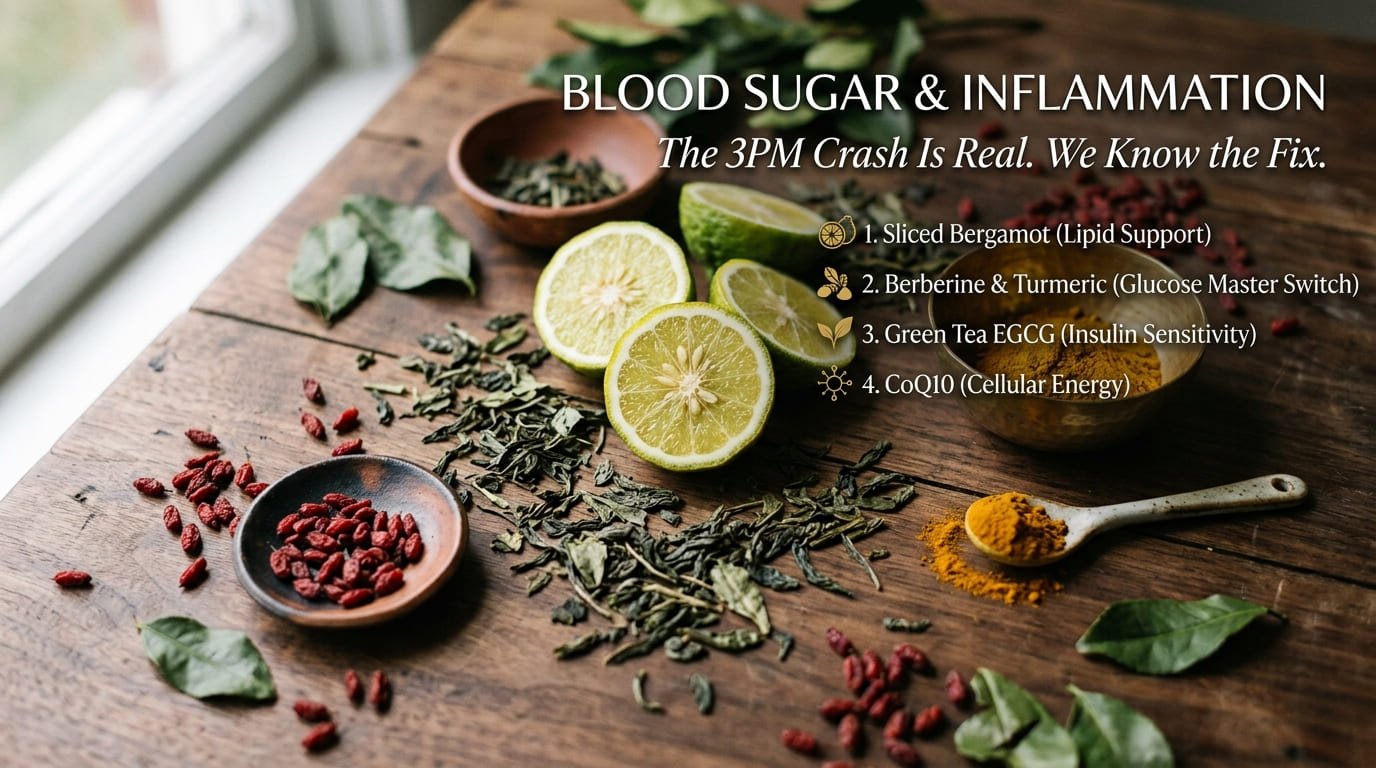
| Berberine | A plant alkaloid found in barberry and related species | Activates AMPK, the body’s metabolic “master switch,” which in turn suppresses NF-κB, a key driver of inflammatory signaling | 500–1,500 mg/day |
| Green tea extract (EGCG) | The dominant catechin in green tea, far more concentrated in extract form than in a cup of tea | Improves insulin signaling and glucose uptake; shown to lower inflammatory markers like CRP over longer-term use | 300–500 mg/day |
Of the four, berberine has the deepest clinical backing on blood sugar specifically — meta-analyses covering thousands of participants show meaningful reductions in fasting glucose and in HOMA-IR, a standard marker of insulin resistance, with effects that hold up reasonably well against metformin in head-to-head comparisons. Citrus bergamot’s strongest data is on lipids: a 2024 randomized, placebo-controlled trial in the journal Foods found that standardized bergamot flavonoids reduced total cholesterol by 8.8% and LDL by 11.5% over four months, alongside a modest rise in HDL. CoQ10’s case is more about replacing what’s lost — statins in particular block a pathway your body also uses to make its own CoQ10, which is why fatigue and muscle soreness are common statin complaints. Green tea’s EGCG has shown measurable drops in CRP, TNF-α, and IL-6 in postmenopausal women taking a high-dose extract for a full year, alongside improved insulin signaling in shorter trials.
Image placeholder · end of this section
Flat-lay photo on a wood board: whole bergamot or citrus fruit sliced open, loose green tea leaves, a small bowl of turmeric or barberry, shot from above in soft natural light. Suggested alt text: “citrus bergamot, green tea, and botanical anti-inflammatory ingredients flat lay.”
Your Daily Anti-Inflammatory Protocol
This is the order that tends to matter most, based on when each lever has the biggest effect on the glucose curve from the chart above.
- MorningProtein before caffeineHave something with real protein — eggs, Greek yogurt, a protein shake — within the first hour of waking, before or alongside coffee. Take citrus bergamot, berberine, and CoQ10 with this meal; all three absorb better with some dietary fat present, and berberine specifically works best taken with food to minimize stomach upset.
- MiddayBuild lunch around protein, then moveLead with protein and vegetables rather than starch. A 10-minute walk within 30 minutes of finishing the meal measurably blunts the glucose spike that follows — muscles pull glucose out of the bloodstream directly, no insulin negotiation required.
- AfternoonSwap the default 3pm snackIf the slump hits anyway, reach for something with protein or fat rather than more refined carbohydrate — nuts, a boiled egg, cheese. This is also a reasonable window for a cup of green tea if you haven’t already worked an EGCG source into your morning stack.
- EveningEarlier dinner, earlier wind-downFinishing dinner two to three hours before bed keeps overnight glucose steadier, and poor sleep independently raises CRP the next day — so the wind-down matters almost as much as the meal itself. This is a reasonable point in the day to skip the nightcap; alcohol produces its own glucose swing on top of everything else.
Our Pick: BergaMet CoQ10 STAT10 — Full Breakdown
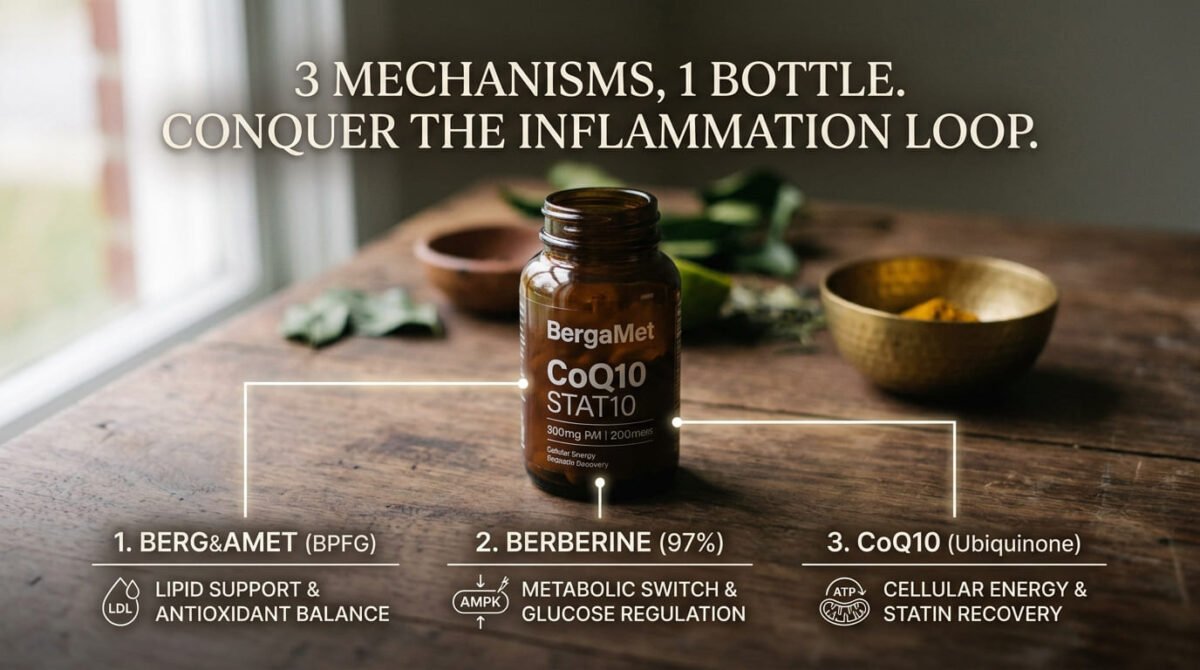
We looked for a single product that covered as many of the four compounds above as possible, without hiding doses behind a vague “proprietary blend.” BergaMet’s STAT10 formula was the clearest match: it pairs the brand’s patented citrus bergamot extract with a clinical-range dose of berberine and CoQ10 in one bottle, which is a genuinely unusual combination to find pre-formulated.
BergaMet · North America
CoQ10 STAT10™
$69.99 / 90 caps
90 capsules, 3 capsules/day — a 30-day supply, roughly $2.33/day. Originally formulated to replenish nutrients statins can deplete, but the ingredient profile lines up closely with everything covered above, statin use or not.
| Ingredient | Amount per 3-capsule serving |
|---|---|
| Citrus Bergamot Extract (47% BPFG) | 500 mg |
| CoQ10 (as ubiquinone) | 200 mg |
| Berberine HCl (97%) | 500 mg |
| Omega-3 (EPA/DHA, fish oil) | 350 mg |
| Vitamin C | 50 mg |
| Resveratrol | included, trace |
What we like
- Full clinical-range berberine (500 mg) and CoQ10 (200 mg) doses, clearly labeled rather than buried in a blend
- Patented, publicly documented BPFG bergamot extraction — you know what fraction of polyphenols you’re actually getting
- Made in a GMP-certified U.S. facility; distributed through integrative and cardiology practices, which is a reasonable trust signal
- Three mechanisms (lipids, cellular energy, glucose/inflammation) in one bottle instead of three
Where it falls short
- Contains fish oil — not vegan or vegetarian
- 3 capsules/day is a bigger pill count than a single softgel product
- No green tea extract in the formula, so pair it separately if you want all four compounds covered
- Roughly double the price of a basic bergamot-only bottle
- A newer SKU than BergaMet’s flagship bergamot extract, so its Amazon review count is still catching up — check current ratings before buying
Who it’s for: people already paying attention to cholesterol or blood sugar who’d rather take one well-dosed product than juggle three. Who should skip it: strict vegans, anyone pregnant or breastfeeding, and anyone on blood-thinners or glucose-lowering medication should talk to a doctor first — berberine can amplify the effect of both.
Affiliate disclosure: if you buy through the link above, Botanica Vitae may earn a small commission at no extra cost to you. This has no bearing on which product we chose to feature.
Image placeholder · inside product section
The BergaMet bottle photographed on a kitchen counter next to a glass of water and a few whole citrus fruits, morning light. Suggested alt text: “BergaMet CoQ10 STAT10 bottle as part of a morning supplement routine.”
Common Problems This Protocol Solves
| What you’re noticing | What’s actually driving it | What helps |
|---|---|---|
| I crash every afternoon | Post-lunch glucose spike and rebound | Protein-forward lunch, a short walk after eating, berberine with the meal |
| I can’t lose the last 10–15 lbs | Visceral fat driving its own inflammatory signaling | Steadier glucose curve first; weight tends to follow, not lead |
| My skin looks tired no matter what I put on it | Glycation of collagen (AGEs) from repeated glucose swings | Lower the swings, add antioxidant polyphenols like bergamot and EGCG |
| I’m on a statin and constantly fatigued | Statin-related CoQ10 depletion | CoQ10 repletion — discuss dose with your prescribing doctor |
Frequently Asked Questions
Does blood sugar really affect my skin, or is that a marketing angle?
It’s a documented mechanism, not marketing. Elevated glucose accelerates glycation, where sugar binds to collagen and forms advanced glycation end-products (AGEs). These stiffen collagen and trigger local inflammation through a receptor called RAGE, and dermatology researchers have linked their buildup directly to visible fine lines and reduced elasticity, independent of sun exposure.How long before I’d actually notice a difference?
Be patient with this one. Most of the human trials behind berberine and citrus bergamot ran 60 to 90 days before showing meaningful changes in blood work. Energy and afternoon crashes often improve sooner, within one to two weeks of steadying meals, but lipid and skin changes take longer to show up.Can’t I just get citrus bergamot from eating oranges?
Not really. Bergamot is a distinct, mostly inedible-on-its-own citrus fruit grown almost exclusively in a small region of Calabria, Italy, and the compounds researchers care about most — melitidin and brutieridin — aren’t found in meaningful amounts in common oranges or grapefruit. That’s why it’s sold as an extract rather than “just eat more citrus” advice.Is berberine safe to take with medication?
Talk to your doctor before starting it if you take metformin, another glucose-lowering medication, or a blood thinner — berberine can amplify both effects. It can also cause mild GI upset in the first week or two for some people, which usually settles down.What’s the real difference between this and a basic bergamot supplement?
A basic bergamot-only bottle covers one of the four mechanisms in this article. STAT10 covers three — bergamot, berberine, and CoQ10 — at clinically relevant doses in one product, which is why it costs roughly double. Whether that trade is worth it depends on whether you’d otherwise be buying two or three separate bottles anyway.Do I need to change my diet too, or is the supplement enough?
The supplement supports the mechanism; it doesn’t replace the meal timing and movement that actually create the glucose curve in the first place. Think of the protocol above as the foundation and the supplement as reinforcement, not the other way around.
Where to Start This Week
Pick one lever, not all four. If mornings are the problem, start with protein before caffeine. If it’s the 3pm wall, add the post-lunch walk before you add anything else. Supplements make the most sense once the daily pattern is already moving in the right direction — they’re reinforcement for a system that’s already changing, not a substitute for one that isn’t.